
The challenges facing our world today are increasingly interconnected. Climate change affects livelihoods and communities. Development decisions influence environmental sustainability. Education shapes how people understand and respond to these challenges. Meanwhile, governments, institutions, businesses and communities need reliable knowledge to make informed decisions. At the Centre for Climate, Education, and Development Research (CCEDR), we believe these challenges require more than awareness. They require research, knowledge, collaboration and action. Our work is built around a simple idea: knowledge should lead to impact. Who We Are CCEDR is focused on advancing climate and development research, promoting sustainability-focused education, and empowering communities and institutions to contribute to climate-resilient and inclusive growth. We see research not simply as the production of information, but as a tool for understanding real-world challenges and developing practical responses. Our long-term ambition is to contribute to a future where communities are better equipped to respond to climate challenges, institutions have access to relevant knowledge, and development creates opportunities that are both inclusive and sustainable. People. Planet. Progress. Together. What We Do Our work connects research, education, community engagement and innovation for impact. 1. Research Good solutions begin with a clear understanding of the problem. We generate and support research that provides evidence and insights into climate, development and related social and economic challenges. By producing relevant knowledge, we aim to support better decisions and more effective interventions. 2. Education & Knowledge Knowledge creates the foundation for meaningful change. Through education, learning and capacity-building initiatives, we promote greater understanding of sustainability and development issues. We believe that individuals and institutions equipped with the right knowledge are better positioned to respond to emerging challenges. 3. Community Engagement Development is ultimately about people. We seek to connect knowledge with communities and real-world needs. Through engagement and collaborative approaches, we aim to support stronger, more inclusive communities and ensure that development solutions are responsive to the people they are intended to serve. 4. Innovation for Impact The challenges of today require new ways of thinking. We are interested in ideas and approaches that can translate knowledge into practical solutions. By connecting research and innovation, we seek to contribute to solutions that can strengthen resilience and support sustainable development. Our Focus Areas While What We Do describes how we work, our focus areas describe where we direct our attention. 1. Climate & Environment Climate change and environmental pressures are increasingly affecting communities, livelihoods and economies. Our focus is on research and solutions that contribute to climate resilience, environmental sustainability and adaptation. 2. Education & Knowledge Education plays a critical role in preparing people and institutions to understand and respond to changing realities. We promote sustainability-focused education, learning and capacity building that can turn knowledge into meaningful action. 3. Development & Inclusive Growth Economic development should create opportunities for people while protecting the resources and systems that support communities. Our work explores practical approaches to inclusive economic growth, sustainable livelihoods and development that leaves no one behind. 4. Policy, Research & Innovation Research has greater value when it can inform decisions. We generate evidence and explore innovative ideas that can contribute to better policies, stronger strategies and improved development outcomes. Why Our Work Matters The need for this work is clear. Climate and development challenges are not isolated issues. They influence how people live, work, learn and build their communities. Stronger, More Resilient Communities Communities need knowledge and practical solutions that can help them respond to changing environmental and development conditions. Research can help identify challenges, understand local realities and develop approaches that strengthen resilience. Better Decisions Through Evidence Good decisions require good information. Whether the decision involves policy, investment, education, community development or environmental management, reliable evidence can help decision-makers understand challenges and identify more effective responses. This is why research must go beyond academic discussions and contribute to real-world decision-making. Inclusive and Sustainable Development Progress should benefit people while considering the long-term health of our environment. Sustainable development requires us to think about economic opportunity, social inclusion and environmental responsibility together. A Greener, Brighter Future Ultimately, our work is about the future. A future where communities are more resilient, institutions are better informed, development is more inclusive and environmental sustainability is treated as an essential part of progress. From Knowledge to Action At CCEDR, we believe that research should not remain on paper. Knowledge matters most when it informs action. That means creating opportunities for researchers, educators, communities, institutions and other stakeholders to exchange ideas, learn from evidence and work together toward practical solutions. Our approach is therefore grounded in a simple progression: Research → Knowledge → Action → Impact Each stage matters. Research helps us understand. Knowledge helps us learn. Action helps us respond. Impact shows whether our efforts are making a difference. Looking Ahead The journey toward a more resilient and sustainable future will require collaboration. No single institution, researcher, community or organization can address the complexity of climate and development challenges alone. Progress will depend on partnerships, shared knowledge, innovation and a willingness to turn evidence into action. CCEDR is committed to being part of that journey. Through our work in climate and environment, education and knowledge, development and inclusive growth, and policy, research and innovation, we aim to contribute to solutions that respond to today’s challenges while preparing for tomorrow’s opportunities. Because a resilient future is not something we simply wait for. It is something we build together. Research for a Resilient Tomorrow. About CCEDR The Centre for Climate, Education, and Development Research (CCEDR) works at the intersection of climate, education and sustainable development, using research, knowledge and innovation to support climate-resilient and inclusive growth. 🌐 www.ccedr.org 📧 @ccedr_global 📞 0542926819 #CCEDR #ClimateResearch #ClimateAction #SustainableDevelopment #ClimateResilience #ResearchForImpact #Education #InclusiveDevelopment #ClimateChange #Africa
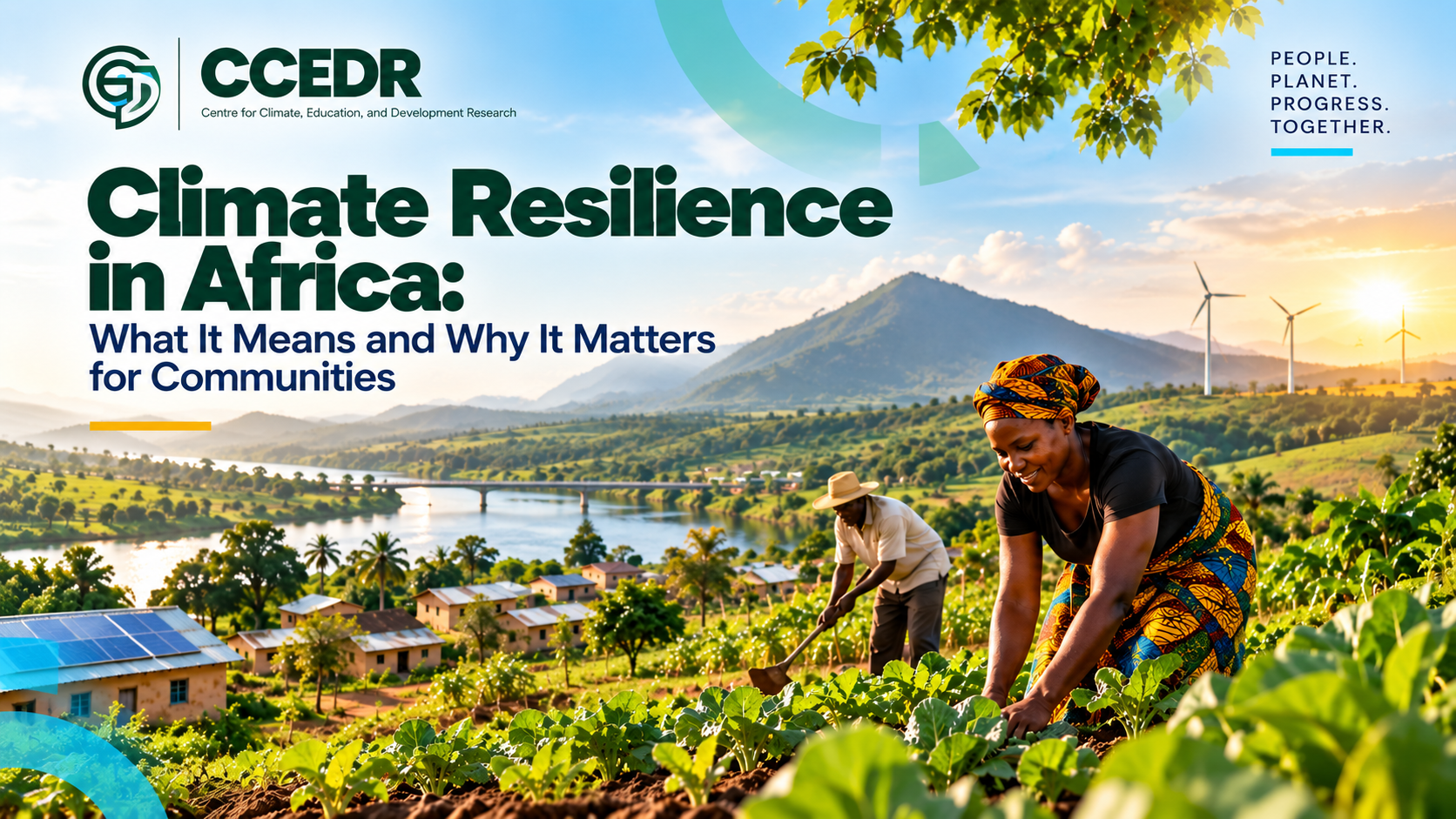
Climate Resilience in Africa: What It Means and Why It Matters for Communities | CCEDR
Climate change is often discussed through global temperatures, greenhouse-gas emissions and international climate agreements. But for communities, climate change is experienced in much more immediate ways: changing rainfall patterns, floods, droughts, heat, pressure on water resources, disrupted livelihoods and damage to infrastructure. This is where climate resilience becomes important. Climate resilience is not simply about recovering after a climate-related shock. It is about strengthening the ability of people, communities, institutions and economies to prepare for, withstand, adapt to and recover from climate-related stresses and shocks. For Africa, this conversation is particularly important. The continent faces significant climate-related risks while also pursuing major development priorities, including poverty reduction, food security, economic growth, infrastructure development and improved access to education and essential services. Building resilience therefore cannot be separated from development. At the Centre for Climate, Education, and Development Research (CCEDR), we see climate resilience as a space where research, education, development and community action must come together. What Is Climate Resilience? Climate resilience refers to the capacity of people, communities, institutions and systems to anticipate climate-related risks, reduce their vulnerability, cope with impacts and adapt to changing conditions. It is closely connected to climate adaptation. Adaptation involves adjustments that help people and systems respond to actual or expected climate impacts. Resilience is broader: it considers not only how a community responds to a particular shock, but also the underlying conditions that determine whether people can prepare, absorb losses, recover and adapt over time. The distinction matters. A community may recover from a flood, for example, but if the same homes, roads and drainage systems remain exposed to repeated flooding, recovery alone does not necessarily create resilience. Building resilience means asking a deeper question: What can be changed today so that the next climate shock causes less disruption? That may involve better infrastructure, stronger early-warning systems, diversified livelihoods, improved access to information, ecosystem protection, social protection, effective institutions and community-led planning. The World Bank similarly identifies access to infrastructure, social services, income and targeted adaptation measures as important components of resilience. (World Bank) Why Climate Resilience Matters in Africa Africa’s climate risks are closely connected to its development challenges. Climate-related shocks can affect agriculture, water availability, health, infrastructure, education, businesses and household incomes. The consequences are not experienced equally: vulnerability can depend on income, location, livelihood, access to services and the capacity of institutions to respond. The World Bank notes that climate shocks can threaten livelihoods and economic stability, while context-specific adaptation can help communities reduce exposure, absorb shocks and recover more effectively. (World Bank) This means climate resilience should not be viewed solely as an environmental issue. It is also a development issue. If a farmer loses a harvest because of changing rainfall patterns, the consequences can extend beyond the farm. Household income may decline. Food security may be affected. Children may face disruptions to education. Local businesses can experience lower demand. Communities may require additional support to recover. A climate shock can therefore become a development setback. Climate Resilience Starts With Communities National policies and international climate commitments are important, but resilience is ultimately experienced at the local level. Communities understand their environments, livelihoods and vulnerabilities in ways that may not always be captured by national datasets. This makes local knowledge an important component of climate resilience. Across Africa, adaptation initiatives have demonstrated the value of combining scientific knowledge with community experience. UNEP, for example, has documented projects involving farmers and communities that combine adaptation measures with local knowledge, ecosystem management and practical interventions. (UNEP – UN Environment Programme) Community participation also helps ensure that interventions respond to actual needs. A solution designed without understanding local conditions may be technically sound but difficult to maintain or unsuitable for the people expected to use it. Resilience therefore works best when communities are not treated simply as beneficiaries, but as participants in identifying problems, developing solutions and evaluating results. 1. Resilient Livelihoods Livelihoods are one of the most important dimensions of climate resilience. Many households depend directly or indirectly on climate-sensitive activities, including agriculture, fisheries, livestock and natural-resource-based enterprises. When climate conditions change, these livelihoods can become more vulnerable. Building resilience can involve: Diversifying income sources Improving access to climate information Supporting climate-smart agricultural practices Strengthening financial resilience Improving access to markets Developing skills for alternative livelihoods Strengthening local value chains The objective is not necessarily to eliminate climate risk—which is often impossible—but to reduce the extent to which a climate shock becomes a long-term economic crisis. 2. Resilient Infrastructure and Basic Services Infrastructure is another major part of resilience. Roads, drainage systems, schools, healthcare facilities, water systems, housing and electricity infrastructure all influence how communities experience climate shocks. Poorly planned infrastructure can increase vulnerability, while resilient infrastructure can reduce disruption. For example, effective drainage can reduce flood impacts, while reliable water systems can help communities cope with periods of water stress. The World Bank’s work on adaptation highlights infrastructure, early-warning systems, disaster preparedness and recovery as important elements of resilience-building. (World Bank) This reinforces an important principle: Climate resilience should be incorporated into development planning from the beginning, rather than added after a disaster occurs. 3. Climate Information and Early Warning Information can save lives, protect livelihoods and improve decision-making. Communities need information that is not only accurate but also accessible and actionable. Early-warning systems can provide information about hazards such as floods, storms, droughts and extreme weather, allowing people and institutions to take preventive action. But producing a forecast is only one part of the process. The information must reach the people who need it, in a form they can understand and act upon. The World Bank identifies stronger climate information systems and early warning as important components of people-centred climate resilience efforts in Africa. (World Bank) This creates an important role for research and communication: turning climate information into usable knowledge. 4. Healthy Ecosystems Can Strengthen Resilience Nature itself can provide important forms of protection. Wetlands, forests, mangroves, soils and other ecosystems can contribute to water management, flood
