
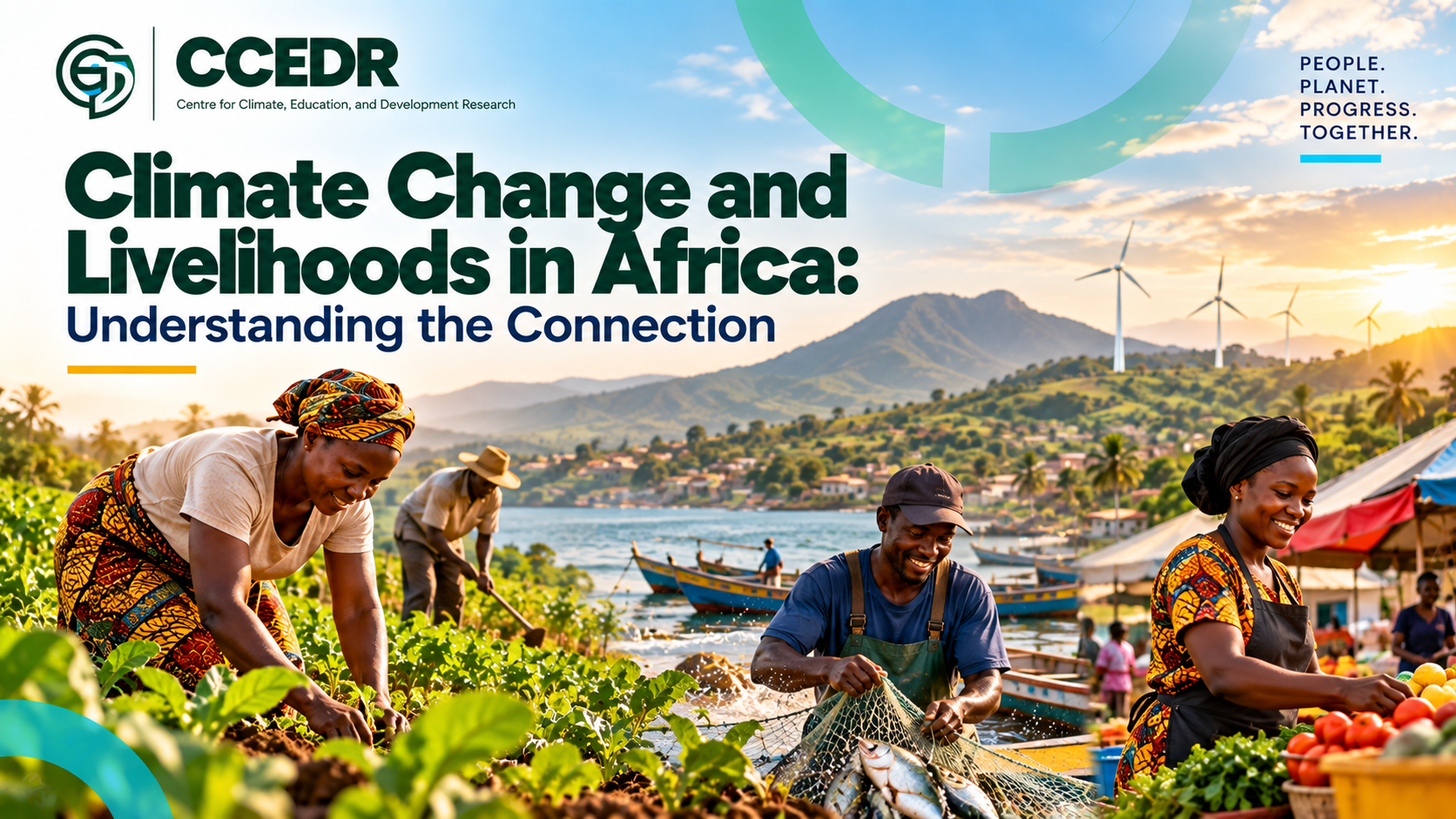
Climate change is often presented as a problem of rising temperatures, changing rainfall patterns, floods, droughts and extreme weather. But behind these environmental changes are people whose livelihoods, incomes, food security and economic opportunities can also be affected. For millions of people across Africa, the connection between climate and livelihoods is especially important because many economic activities depend directly or indirectly on natural resources and weather conditions. Agriculture is one obvious example. But the relationship extends much further—to fisheries, livestock, tourism, informal businesses, construction, energy, transport and other activities that depend on functioning ecosystems, infrastructure and stable economic conditions. The Intergovernmental Panel on Climate Change (IPCC) identifies Africa’s climate vulnerability as multidimensional, with environmental, economic and social factors interacting. It also notes that climate-exposed sectors employ a large share of the workforce in sub-Saharan Africa. (IPCC) Understanding this connection is essential if climate action is to contribute to sustainable and inclusive development. What Is a Livelihood? A livelihood is more than a person’s job. It includes the skills, resources, activities and relationships that people rely on to meet their needs and sustain their households. For a smallholder farmer, this might involve land, labour, rainfall, seeds, access to markets, finance and agricultural knowledge. For a fisher, it may depend on healthy aquatic ecosystems, equipment, access to markets and predictable conditions. For a small business owner, livelihood security may depend on customers, infrastructure, electricity, transportation, finance and the wider economy. This means that climate change can affect livelihoods through several different pathways. A change in rainfall can affect agricultural production. A flood can damage roads, homes, shops and equipment. Extreme heat can affect working conditions and productivity. Damage to ecosystems can affect fisheries, forestry and tourism. And when these disruptions occur repeatedly, households may find it increasingly difficult to recover and maintain stable incomes. Agriculture: One of the Clearest Connections Agriculture provides one of the clearest examples of the relationship between climate change and livelihoods in Africa. Rainfall, temperature and water availability influence agricultural production. Changes in these conditions can affect what farmers grow, when they plant and harvest, how much they produce and the resources required to maintain production. FAO notes that African countries are experiencing increasing climate variability, including floods, droughts and changing rainfall patterns, with consequences for agricultural production, food security and the incomes of vulnerable populations. (FAOHome) The challenge is particularly important for smallholder farmers. Research summarized by FAO identifies constraints such as limited access to land, capital, labour, irrigation water, information and other productive assets as barriers to adaptation in sub-Saharan African farming systems. (FAOHome) This demonstrates an important point: Climate vulnerability is not determined by climate alone. Two farmers may experience the same rainfall shortage but face very different consequences depending on their access to irrigation, finance, information, markets and alternative sources of income. Climate Change Can Affect More Than Production The effects of climate change do not stop when a crop fails. Consider a farming household whose harvest is significantly reduced. Lower production can mean: Less income → reduced household spending → difficulty meeting expenses → increased financial pressure. The consequences can then extend into the local economy. If many households in the same community experience similar losses, local businesses may also experience reduced demand. This is why climate change can become a development challenge. The impact of a climate event can move through households, businesses, markets and institutions. The World Bank has warned that climate shocks in sub-Saharan Africa can threaten economic growth and push vulnerable populations further into poverty. (World Bank) Fisheries, Livestock and Natural Resources Agriculture is not the only climate-sensitive livelihood. Communities that depend on fisheries, livestock, forests and other natural resources can also be exposed to environmental changes. The IPCC identifies significant climate risks for African fisheries and livestock systems and notes that livelihood diversification and practices such as agroforestry and improved agricultural systems can contribute to resilience. (IPCC) These sectors are interconnected. For example, changes in water availability can affect livestock. Changes in aquatic ecosystems can affect fishing. Changes in vegetation can influence both livestock and agriculture. This interconnectedness means that climate adaptation cannot always be approached one sector at a time. Climate Change and Jobs The relationship between climate change and livelihoods also extends to employment. Climate-related changes can affect where economic opportunities exist, the productivity of certain sectors and the skills that workers need. At the same time, the transition toward greener and more sustainable economies can create new opportunities in areas such as renewable energy, sustainable agriculture, environmental services, resource efficiency and climate-related technologies. The International Labour Organization has highlighted the connection between climate change, employment and social protection in Africa, emphasizing the role of skills and social protection in responding to climate-related challenges. (International Labour Organization) The ILO and UNDRR have also identified decent jobs, skills development and local capacity building as important elements of resilience in Africa. (International Labour Organization) This creates an important opportunity. Climate action does not have to be viewed only as a cost. With appropriate policies, investment and skills development, the transition toward climate-resilient economies can also support new forms of economic activity and employment. Why Vulnerability Is Not the Same for Everyone One of the most important things to understand about climate change is that its effects are not evenly distributed. People’s ability to prepare for and respond to climate-related shocks depends on their resources and circumstances. Factors such as: Income Access to finance Education and skills Access to climate information Land and natural resources Infrastructure Social protection Access to markets Location Institutional support can all influence resilience. The IPCC highlights the interaction between socioeconomic, political and environmental factors in determining vulnerability across Africa. (IPCC) This is why climate policy needs to consider who is most exposed, who has the fewest resources to adapt and what barriers prevent people from accessing solutions. Women and Young People Matter Climate and livelihood discussions also need to consider different groups within communities. Women and young people can experience climate-related economic pressures
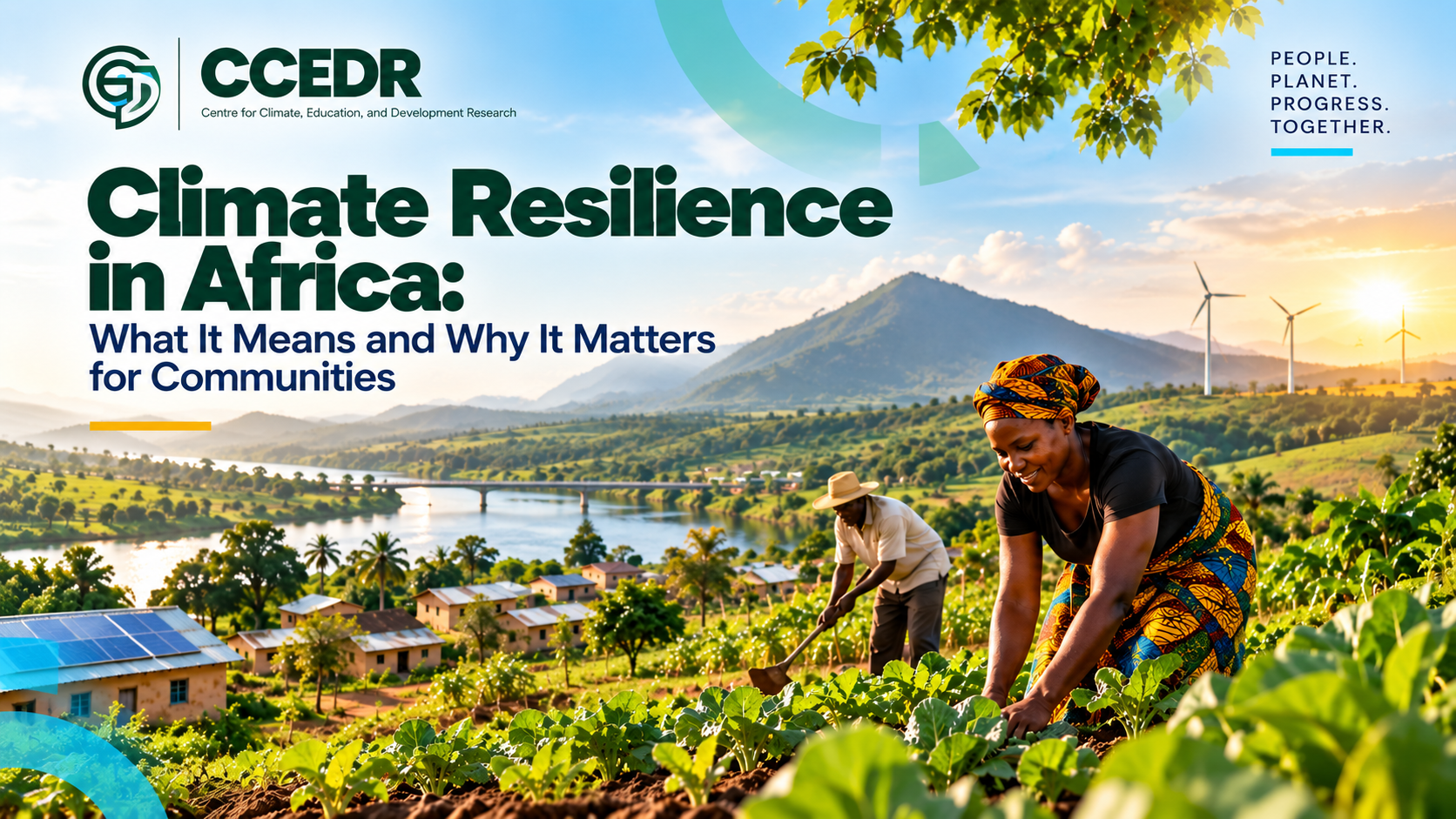
Climate Resilience in Africa: What It Means and Why It Matters for Communities | CCEDR
Climate change is often discussed through global temperatures, greenhouse-gas emissions and international climate agreements. But for communities, climate change is experienced in much more immediate ways: changing rainfall patterns, floods, droughts, heat, pressure on water resources, disrupted livelihoods and damage to infrastructure. This is where climate resilience becomes important. Climate resilience is not simply about recovering after a climate-related shock. It is about strengthening the ability of people, communities, institutions and economies to prepare for, withstand, adapt to and recover from climate-related stresses and shocks. For Africa, this conversation is particularly important. The continent faces significant climate-related risks while also pursuing major development priorities, including poverty reduction, food security, economic growth, infrastructure development and improved access to education and essential services. Building resilience therefore cannot be separated from development. At the Centre for Climate, Education, and Development Research (CCEDR), we see climate resilience as a space where research, education, development and community action must come together. What Is Climate Resilience? Climate resilience refers to the capacity of people, communities, institutions and systems to anticipate climate-related risks, reduce their vulnerability, cope with impacts and adapt to changing conditions. It is closely connected to climate adaptation. Adaptation involves adjustments that help people and systems respond to actual or expected climate impacts. Resilience is broader: it considers not only how a community responds to a particular shock, but also the underlying conditions that determine whether people can prepare, absorb losses, recover and adapt over time. The distinction matters. A community may recover from a flood, for example, but if the same homes, roads and drainage systems remain exposed to repeated flooding, recovery alone does not necessarily create resilience. Building resilience means asking a deeper question: What can be changed today so that the next climate shock causes less disruption? That may involve better infrastructure, stronger early-warning systems, diversified livelihoods, improved access to information, ecosystem protection, social protection, effective institutions and community-led planning. The World Bank similarly identifies access to infrastructure, social services, income and targeted adaptation measures as important components of resilience. (World Bank) Why Climate Resilience Matters in Africa Africa’s climate risks are closely connected to its development challenges. Climate-related shocks can affect agriculture, water availability, health, infrastructure, education, businesses and household incomes. The consequences are not experienced equally: vulnerability can depend on income, location, livelihood, access to services and the capacity of institutions to respond. The World Bank notes that climate shocks can threaten livelihoods and economic stability, while context-specific adaptation can help communities reduce exposure, absorb shocks and recover more effectively. (World Bank) This means climate resilience should not be viewed solely as an environmental issue. It is also a development issue. If a farmer loses a harvest because of changing rainfall patterns, the consequences can extend beyond the farm. Household income may decline. Food security may be affected. Children may face disruptions to education. Local businesses can experience lower demand. Communities may require additional support to recover. A climate shock can therefore become a development setback. Climate Resilience Starts With Communities National policies and international climate commitments are important, but resilience is ultimately experienced at the local level. Communities understand their environments, livelihoods and vulnerabilities in ways that may not always be captured by national datasets. This makes local knowledge an important component of climate resilience. Across Africa, adaptation initiatives have demonstrated the value of combining scientific knowledge with community experience. UNEP, for example, has documented projects involving farmers and communities that combine adaptation measures with local knowledge, ecosystem management and practical interventions. (UNEP – UN Environment Programme) Community participation also helps ensure that interventions respond to actual needs. A solution designed without understanding local conditions may be technically sound but difficult to maintain or unsuitable for the people expected to use it. Resilience therefore works best when communities are not treated simply as beneficiaries, but as participants in identifying problems, developing solutions and evaluating results. 1. Resilient Livelihoods Livelihoods are one of the most important dimensions of climate resilience. Many households depend directly or indirectly on climate-sensitive activities, including agriculture, fisheries, livestock and natural-resource-based enterprises. When climate conditions change, these livelihoods can become more vulnerable. Building resilience can involve: Diversifying income sources Improving access to climate information Supporting climate-smart agricultural practices Strengthening financial resilience Improving access to markets Developing skills for alternative livelihoods Strengthening local value chains The objective is not necessarily to eliminate climate risk—which is often impossible—but to reduce the extent to which a climate shock becomes a long-term economic crisis. 2. Resilient Infrastructure and Basic Services Infrastructure is another major part of resilience. Roads, drainage systems, schools, healthcare facilities, water systems, housing and electricity infrastructure all influence how communities experience climate shocks. Poorly planned infrastructure can increase vulnerability, while resilient infrastructure can reduce disruption. For example, effective drainage can reduce flood impacts, while reliable water systems can help communities cope with periods of water stress. The World Bank’s work on adaptation highlights infrastructure, early-warning systems, disaster preparedness and recovery as important elements of resilience-building. (World Bank) This reinforces an important principle: Climate resilience should be incorporated into development planning from the beginning, rather than added after a disaster occurs. 3. Climate Information and Early Warning Information can save lives, protect livelihoods and improve decision-making. Communities need information that is not only accurate but also accessible and actionable. Early-warning systems can provide information about hazards such as floods, storms, droughts and extreme weather, allowing people and institutions to take preventive action. But producing a forecast is only one part of the process. The information must reach the people who need it, in a form they can understand and act upon. The World Bank identifies stronger climate information systems and early warning as important components of people-centred climate resilience efforts in Africa. (World Bank) This creates an important role for research and communication: turning climate information into usable knowledge. 4. Healthy Ecosystems Can Strengthen Resilience Nature itself can provide important forms of protection. Wetlands, forests, mangroves, soils and other ecosystems can contribute to water management, flood
