The Role of Climate Education in Building a Sustainable Future
By CCEDR — Centre for Climate, Education, and Development Research
Climate change is often discussed through statistics, policies, emissions targets and environmental impacts. But behind every climate challenge is a human decision: how we produce food, use energy, manage land and water, design cities, build businesses, and respond to changing environmental conditions.
This is why education matters. Climate education is not simply about teaching people what climate change is. It is about developing the knowledge, skills, values and capacity needed to understand climate risks, make informed decisions and participate in solutions.
UNESCO describes climate change education as an important tool for equipping people to become agents of change, while the UNFCCC places education, training, public awareness and participation at the centre of its Action for Climate Empowerment framework. (UNESCO)
For Africa, where climate change intersects with livelihoods, development, infrastructure, food systems and economic opportunity, strengthening climate education can be an important part of building a more sustainable and resilient future.
What Is Climate Education?
Climate education refers to learning that helps people understand climate change, its causes and impacts, and the actions that can reduce risks and support adaptation.
It can take place in many settings:
- Schools and universities
- Vocational and technical institutions
- Community programmes
- Workplaces
- Farmer training programmes
- Public awareness campaigns
- Research and professional development
- Digital and informal learning platforms
Effective climate education therefore goes beyond the classroom. The UNFCCC’s Action for Climate Empowerment framework connects climate action with six areas: education, training, public awareness, public participation, public access to information and international cooperation. (UNFCCC)
This broader approach is important because climate action requires participation from more than scientists and policymakers. Farmers, entrepreneurs, teachers, engineers, financial professionals, local leaders, young people and communities all make decisions that influence resilience and sustainability.
Why Climate Education Matters
1. It Builds Climate Literacy
People cannot respond effectively to a challenge they do not understand.
Climate literacy helps individuals understand concepts such as:
- Climate variability and climate change
- Extreme weather and climate risks
- Adaptation and resilience
- Mitigation
- Biodiversity and ecosystem protection
- Sustainable resource use
- Renewable energy
- Climate-smart livelihoods
UNESCO identifies knowledge, skills, values and attitudes as important components of climate and sustainability education. (UNESCO)
But climate literacy should also be connected to people’s everyday realities. A farmer may need information about changing rainfall patterns and resilient agricultural practices. A business owner may need to understand climate-related risks to supply chains. A city planner may need to consider flooding and heat when designing infrastructure. A student may need the knowledge and skills to participate in future green industries.
Education becomes most meaningful when people can connect what they learn to the decisions they face.
2. Climate Education Can Turn Knowledge Into Action
Knowing that climate change exists is only the beginning.
The bigger question is:
What can people do with that knowledge?
This is where action-oriented education becomes important. UNESCO’s guidance on greening curricula calls for approaches that are more action-oriented, holistic, scientifically accurate and connected to lifelong learning. (UNESCO)
For example, instead of learning about environmental degradation only through textbooks, learners could explore:
- Local environmental challenges
- Waste management
- Water conservation
- Sustainable agriculture
- Energy efficiency
- Ecosystem restoration
- Community resilience
- Climate-related entrepreneurship
This approach helps connect learning with real-world problem solving.
3. Schools Can Become Spaces for Climate Action
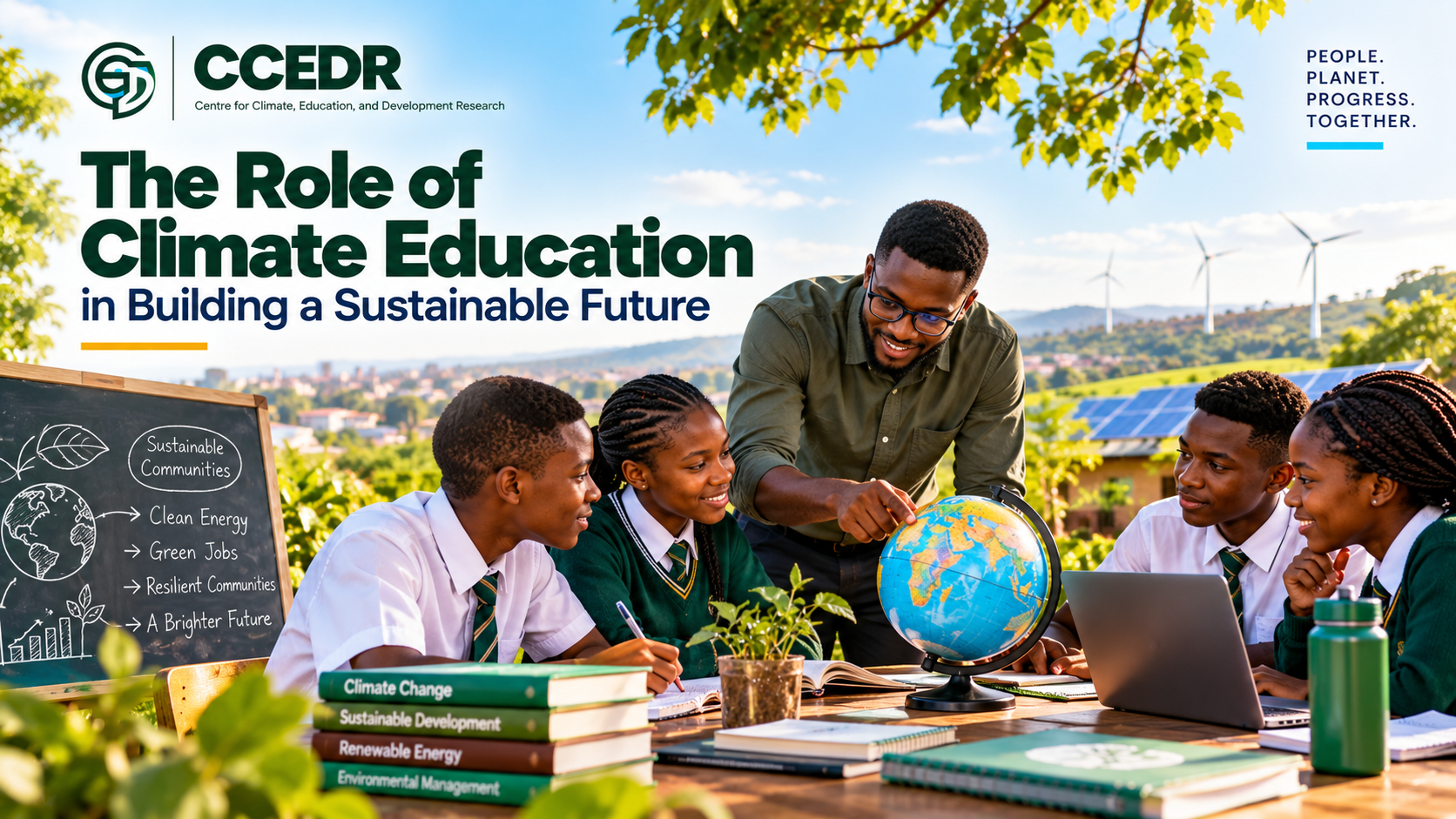
Schools are more than places where students receive information. They can become environments where sustainable practices are learned, demonstrated and applied.
This could include:
- School gardens
- Tree planting and biodiversity projects
- Waste reduction programmes
- Water conservation
- Renewable energy demonstrations
- Climate clubs
- Environmental research projects
- Community engagement activities
UNESCO’s Greening Education Partnership promotes approaches that integrate climate and sustainability across learning, school operations, teacher development and wider education systems. (UNESCO)
The objective is not simply to create students who know more about climate change. It is to help create learners who can understand problems, evaluate solutions and contribute to change.
4. Teachers Are Central to Climate Education
Even the strongest curriculum depends on the people delivering it. Teachers and educators play an important role in translating complex climate issues into learning that students can understand and apply.
UNESCO’s 2026 work on greening teacher training emphasizes the need to equip educators with the knowledge, tools and support required to integrate climate change and sustainability into teaching. (UNESCO)
This means climate education should not only focus on students. Teachers need support too.
Professional development can help educators:
- Understand climate science
- Connect climate issues to different subjects
- Use local examples
- Facilitate discussions and projects
- Encourage critical thinking
- Connect classroom learning with community action
In this way, investing in teachers becomes an investment in the wider climate knowledge system.
5. Climate Education Must Reflect Local Realities
Climate change is global, but its impacts are experienced locally. A community dependent on farming may experience climate change differently from a coastal fishing community or a rapidly growing urban area. This means climate education should not rely entirely on generic examples.
Learning should reflect local ecosystems, livelihoods, cultures, economic realities and community priorities. UNESCO’s work in Madagascar provides an example of climate education being connected to local realities, including farming, fishing, tourism and ecosystem pressures. (UNESCO)
For African education systems, this principle is particularly important.
Students should be able to ask:
What does climate change mean for my community?
What risks are we already experiencing?
What knowledge do we need to respond?
What solutions can we develop locally?
6. Young People Have an Important Role
Africa has a large and growing youth population. This makes education particularly important for the continent’s long-term climate and development trajectory. Young people are not only future leaders. They are already participating in communities, businesses, research, technology, advocacy and innovation.
The UNFCCC has highlighted youth participation in the development of effective climate education policies and approaches. (UNFCCC)
Climate education can therefore create opportunities for young people to:
- Develop green skills
- Conduct research
- Build climate-focused businesses
- Participate in community projects
- Develop technological solutions
- Engage in public decision-making
- Pursue careers connected to the green economy
Education can help move young people from being passive recipients of climate information to active contributors to climate solutions.
7. Climate Education Supports Sustainable Development
Climate change cannot be separated from development. Climate risks can affect agriculture, health, infrastructure, livelihoods, education, businesses and economies. For this reason, climate education should connect environmental knowledge with broader development questions.
Students and communities can explore the relationship between:
Climate + Agriculture + Food Security
Climate + Finance + Investment
Climate + Technology + Innovation
Climate + Education + Skills
Climate + Health + Well-being
Climate + Economic Development
This integrated approach reflects the reality that climate change is not an isolated environmental issue. It is a development challenge that requires interdisciplinary solutions.
UNESCO’s Education for Sustainable Development framework similarly emphasizes knowledge, skills, values and behaviors that support environmental, economic and social well-being. (UNESCO)
8. Climate-Resilient Education Systems Matter Too
There is another side to the relationship between climate and education. Climate change can disrupt education itself.
Floods, droughts, extreme heat and other climate-related hazards can affect school infrastructure, attendance, learning continuity and the wider well-being of students and teachers. UNICEF’s strategy for Eastern and Southern Africa notes that climate-related hazards have already disrupted schooling across countries in the region and calls for climate-resilient education systems. (UNICEF)
This means countries need to think about two connected priorities:
Education for climate resilience
and
Climate resilience for education.
Schools need both the knowledge to respond to climate change and the systems, infrastructure and planning needed to continue learning when climate-related disruptions occur.
From Climate Awareness to Climate Capability
One of the biggest opportunities for climate education is to move beyond awareness.
Awareness asks:
Do people understand the problem?
Climate capability asks:
Do people have the knowledge and skills to respond?
This distinction matters. A farmer may understand that rainfall is becoming less predictable but still need access to information, finance, technology and training to change production practices. A student may understand climate change but need practical opportunities to develop research, innovation or entrepreneurial skills. A policymaker may understand climate risks but need reliable evidence to design effective interventions.
Education therefore works best when it is connected to research, institutions, finance, technology, policy and community action.
What Should Climate Education Look Like in Africa?
A strong approach to climate education in Africa should be:
Context-specific: Learning should reflect local climate risks, economies and communities.
Evidence-based: Climate education should be grounded in reliable scientific research and credible local knowledge.
Practical: Learners should have opportunities to apply knowledge to real-world challenges.
Inclusive: Climate education should reach different age groups, communities and socioeconomic groups.
Skills-oriented: Learning should help people develop practical skills for resilience and sustainable development.
Interdisciplinary: Climate issues should connect environmental science with economics, agriculture, technology, finance, governance and social development.
Lifelong: Climate learning should not stop when someone leaves school. Communities, professionals and institutions also need opportunities to continue learning.
The Role of Research and Innovation
Education and research should work together. Research helps us understand emerging climate risks, identify effective interventions and generate evidence for decision-making.
Education helps translate that knowledge into skills, understanding and action. Innovation then provides opportunities to develop new solutions. Together, these three areas can create a powerful cycle:
RESEARCH → KNOWLEDGE → SKILLS → ACTION → IMPACT
This is particularly relevant for organisations working at the intersection of climate, education and development.
The CCEDR Perspective
At CCEDR, we see education as an important pathway between knowledge and action.
Climate challenges require more than awareness. They require people and institutions that can understand evidence, develop practical solutions and participate meaningfully in decisions affecting their communities and environments.
Our interest in climate and sustainability-focused education is therefore connected to our broader work in research, community engagement, development and innovation.
By strengthening knowledge and capacity, we can contribute to communities and institutions that are better equipped to navigate a changing climate.
Building a Sustainable Future Through Learning
The transition towards a more sustainable future will require new technologies, stronger policies, better research and greater investment. But it will also require people who have the knowledge and skills to make those solutions work. Climate education can help create those capabilities.
The goal is not simply to teach people about climate change. It is to help people understand it, question it, respond to it and develop solutions for it. For Africa, this means building education systems and learning opportunities that connect climate knowledge with local realities, economic development and community needs.
Because a sustainable future is not built by knowledge alone. Knowledge must lead to action. And action begins with learning.